Electrodeposition of CZTS Thin Films with Na₂SO₃ Additive for Improved Photoelectrochemical Water Splitting Efficiency
DOI:
https://doi.org/10.56425/cma.v5i1.118Keywords:
electrodeposition, CZTS, photoelectrochemical, additiveAbstract
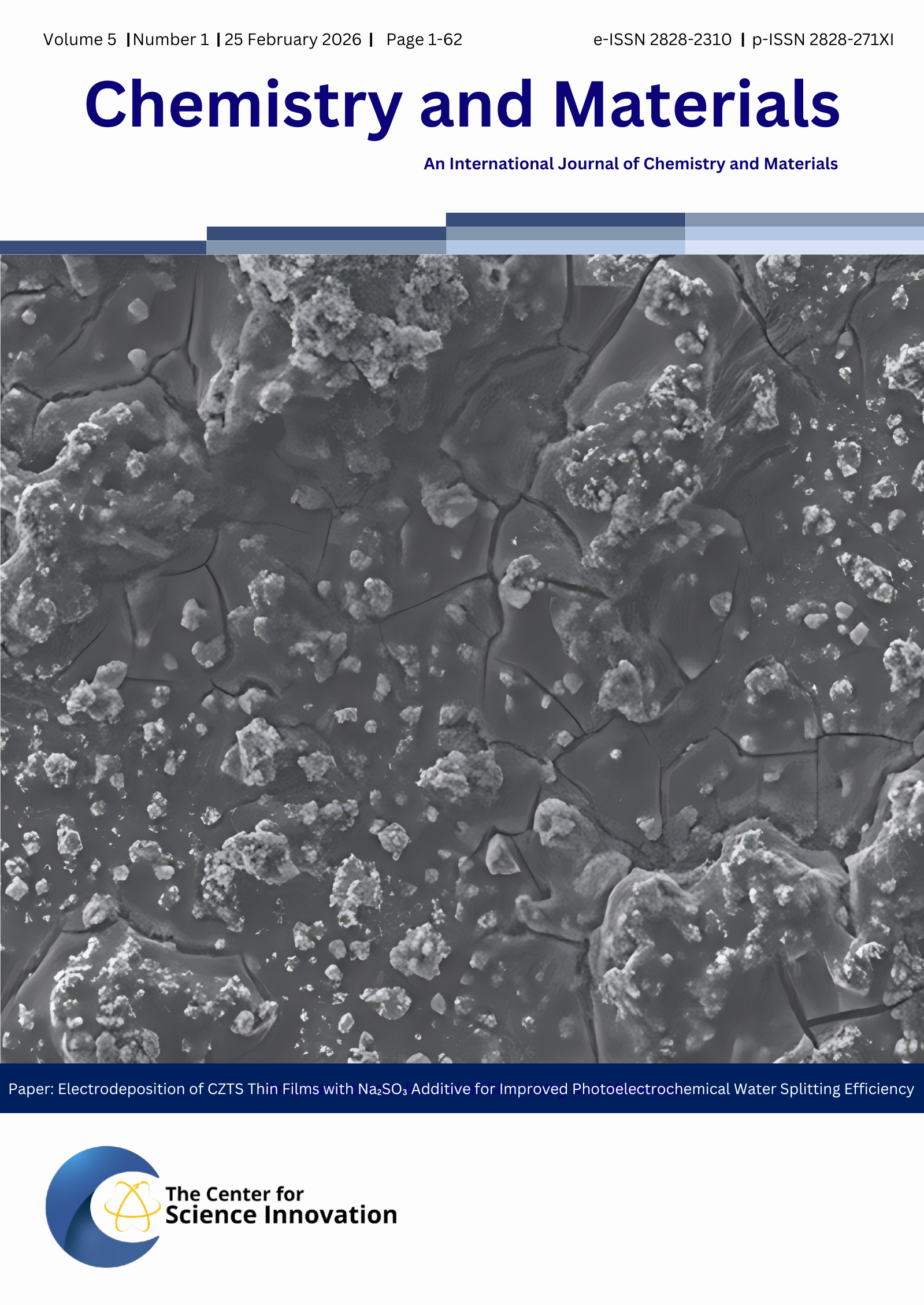
The global transition toward sustainable energy has accelerated research into clean hydrogen production, with photoelectrochemical (PEC) water splitting emerging as a promising pathway. In this study, Cu₂ZnSnS₄ (CZTS) thin films were prepared through one-step electrodeposition using sodium sulfite (Na₂SO₃) as an additive on indium tin oxide (ITO)-coated glass substrates. Structural characterization confirmed the formation of a crystalline kesterite phase, with the enhanced intensity of the (112) peak indicating improved crystallinity upon additive incorporation. Surface morphology and composition analysis revealed compact films with a uniform elemental distribution. PEC measurements showed a significant increase in photocurrent density from 7.4 mA/cm² to 22.3 mA/cm² at 1.47 V vs. RHE with Na₂SO₃ attributed to enhanced light absorption and efficient charge carrier separation. Optical analysis indicated a bandgap widening from 1.50 eV to 1.60 eV, consistent with a reduction in crystallite size. Impedance analysis showed lower charge transfer resistance under illumination. Hydrogen and oxygen evolution reaction (HER and OER) tests demonstrated lower overpotential and Tafel slopes, indicating faster reaction kinetics. Improved stability was confirmed by a positive shift in the corrosion potential (Ecorr) and a lower corrosion current density (icorr).. Overall, the addition of Na₂SO₃ enhanced the structural, optical, catalytic, and stability properties, making CZTS suitable for solar-driven hydrogen evolution.
Downloads
Published
Issue
Section
License
Copyright (c) 2025 Dyah Ayu Larasati, Dyra Aulia Zhafirah, Reinardo Ramawijaya Widakusuma

This work is licensed under a Creative Commons Attribution 4.0 International License.