Dense Granular vs Sparse Agglomerated Morphology in Ni–Fe–Sn Electrocatalysts for Ethanol Oxidation Reaction
DOI:
https://doi.org/10.56425/cma.v5i2.142Keywords:
EOR, morphology-dependent catalysis, Ni–Fe–Sn catalystAbstract
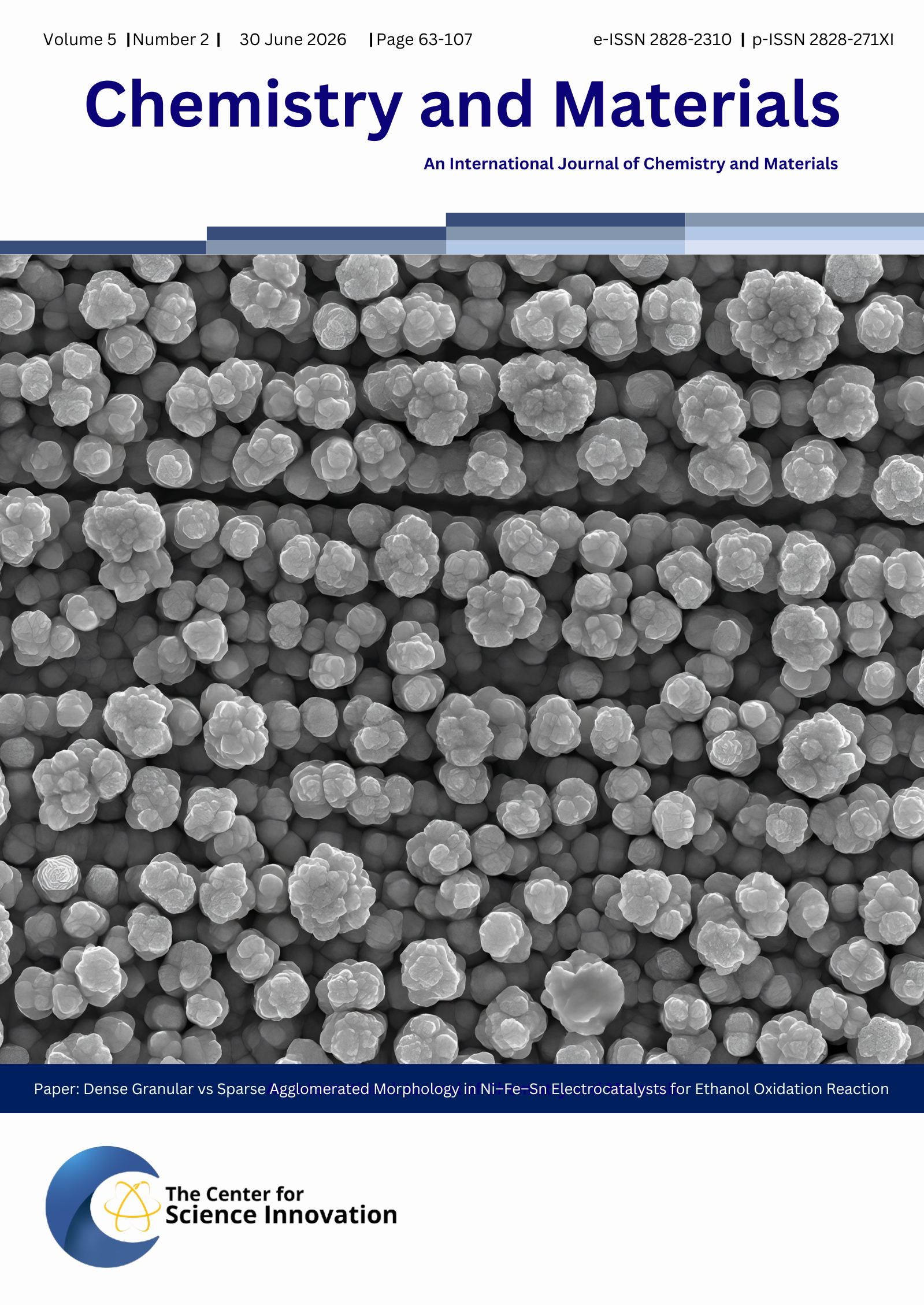
The development of efficient and durable non-noble-metal electrocatalysts for the ethanol oxidation reaction (EOR) remains challenging due to limitations associated with sluggish kinetics and catalyst poisoning. Herein, a morphology-driven strategy is proposed to elucidate the role of granular and compact architectures in governing the electrocatalytic performance of ternary Ni–Fe–Sn catalysts. NiFeSn electrocatalysts were synthesized via potentiostatic electrodeposition. This work provides a comparative investigation of how morphological evolution influences interfacial kinetics, catalytic activity, and operational stability during EOR. Scanning electron microscopy (SEM) analysis revealed that NiFeSn(A) possessed a densely packed granular morphology with uniformly distributed quasi-spherical particles, whereas NiFeSn(B) exhibited sparse surface coverage and localized agglomeration. Electrochemical evaluation demonstrated that NiFeSn(A) achieved superior EOR performance with a peak current density of 117.61 mA cm⁻², 1.60-fold higher than NiFeSn(B) (73.47 mA cm⁻²), together with a lower onset potential (570 mV), lower charge-transfer resistance (2.84 Ω after cycling), and smaller Tafel slope (33.26 mV dec⁻¹). Furthermore, NiFeSn(A) exhibited enhanced poisoning tolerance and improved long-term stability during chronoamperometric measurements. The superior performance of NiFeSn(A) is attributed to its interconnected granular morphology, which promotes charge-transfer kinetics, active-site accessibility, and efficient oxidative removal of poisoning intermediates, highlighting morphology engineering as an effective route for developing high-performance Ni-based EOR electrocatalysts.
Downloads
Published
Issue
Section
License
Copyright (c) 2026 Juliandi Siregar, Muhammad Fathar Aulia

This work is licensed under a Creative Commons Attribution 4.0 International License.